Kalosum
Last ChristmasKalosum is a faction in the war against Mavromino, first encountered here as the recipient of intelligence passed by a double agent and later as the side Caleb (Malphas) chooses to defend. Its significance lies not only in the military alignment it represents but in the alternative it offers Caleb: a chance to fight against a power he fears will continue to enslave his kind, even after victory.
Identity and Wartime Position
The evidence places Kalosum on the opposing side of a conflict in which Caleb had previously fought against it. Its forces are present under Itzal’s command, and Caleb’s eventual choice is recognized by both Itzal and Myone as a change of allegiance. The available scenes do not set out Kalosum’s government, leadership, or full military aims; they define the faction through its position in this war and through the people who carry information to it or fight on its behalf.
Kalosum also receives intelligence from within the opposing camp. Caleb identifies Xevikan as the double agent who has been giving their intelligence to Kalosum. Xevikan does not deny the accusation; he describes himself as made of equal parts good and bad and credits a gentle nudge with sending him in the right direction. The exchange connects Kalosum to a covert flow of information, while leaving the scale and specific contents of Xevikan’s disclosures unstated. For Caleb, the discovery is consequential because it reveals something previously unknown about his brother.
Intelligence and Allegiance
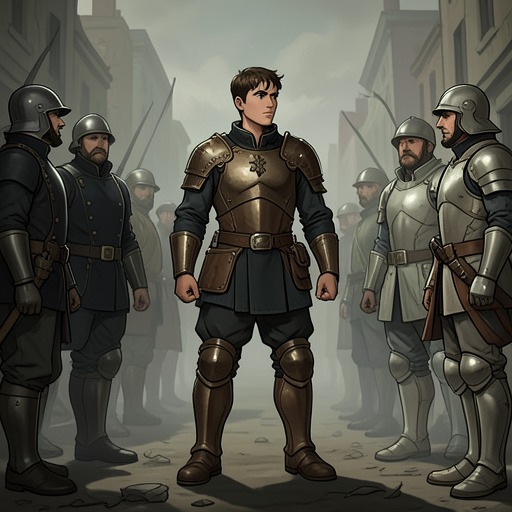
Caleb’s relationship to Kalosum changes sharply. He had fought against the faction, but eventually orders Itzal to withdraw his forces and makes clear that refusal will make them enemies. When Itzal realizes Caleb is serious and asks whether he has joined the opposing side, Caleb accepts that this is how the choice appears. He draws his sword but asks his brother not to force him to hurt him. The moment makes the shift concrete: this is not an abstract sympathy for Kalosum, but a decision that could set Caleb against someone close to him and bring violence between them.
Myone’s response publicly confirms Caleb’s new position. When she calls for the fighting to stop, she tells those present that Caleb is fighting for them and must not be harmed. Her intervention protects him from immediate attack and gives his alignment recognition from the side he has chosen. Caleb is struck by the fact that she has stood up for him and vouched for him; he compares this with the earlier support he had received only from Lilliana. Kalosum’s side is thus shown not just as a line of battle, but as a group in whose defense Myone is willing to speak for Caleb.
Why Caleb Chooses Its Side
Caleb’s account of the stakes is shaped by the treatment his kind has endured. He explains that they are routinely killed, captured, or enslaved, even by the dark lords they serve, and that they are allowed freedom only while war continues. He had fought hard against Kalosum partly because a longer war meant less risk of the dark ones leashing his powers and freedom. His earlier opposition, then, was bound up with the temporary latitude war gave him, not simply with an uncomplicated loyalty to the force that ruled over him.
That calculation changes when Caleb considers what would happen if Mavromino won. He believes his kind would be better off under a Kalosum victory, since Kalosum might show them mercy; Mavromino, by contrast, would tear them apart even in victory. He describes Mavromino as existing to abuse and subjugate their kind. This is Caleb’s judgment of the alternatives, not proof that Kalosum has already granted mercy or a detailed account of how it would govern. Its importance in his decision is comparative: against the subjugation he expects from Mavromino, Kalosum appears to offer at least the possibility of a different outcome.
Consequences and Narrative Significance
Caleb’s defection exposes him to immediate conflict with former allies. His appeal to Itzal is both a warning and a plea: he is prepared to stand against his brother, but does not want to hurt him. Myone’s defense briefly shifts the danger, turning a potential attack on Caleb into public acknowledgment that he is fighting alongside her side. The scenes make allegiance personal and costly, rather than treating it as a change of military label alone.
The choice also reveals the vulnerability behind Caleb’s apparent change of side. He later learns that his mother and the King of All Darkness have worked out why he disappeared and then appeared on the wrong side. Caleb recognizes that he has betrayed himself through this decision: he has made his weakness legible. The reason is Lilliana. This does not establish a policy or motive for Kalosum, but it clarifies why its cause has become inseparable from Caleb’s own: his willingness to join it is connected to the person he loves, even as his judgment of Mavromino’s future rule gives the decision a wider stake for his kind.
Kalosum therefore functions in these scenes as both a military opponent turned ally and a possible refuge from a more certain form of oppression. The narrative keeps that possibility qualified: Caleb hopes Kalosum may show mercy, while the evidence does not confirm what it would do. The contrast nonetheless drives his reversal. A faction he once fought becomes the side he defends, and the change binds battlefield allegiance to family, freedom, and the danger of having one’s deepest attachments discovered.